
Interpretation logic and output#
Interpreted AMRFinderplus output#
When given an AMRFinderPlus input file, and an organism, AMRrules will apply the most relevant organism-specific rule to each AMRFinderPlus AMR genotype call. Below is an abbreviated example of the interpreted output file generated by AMRrules. (More examples can be found in Tests).
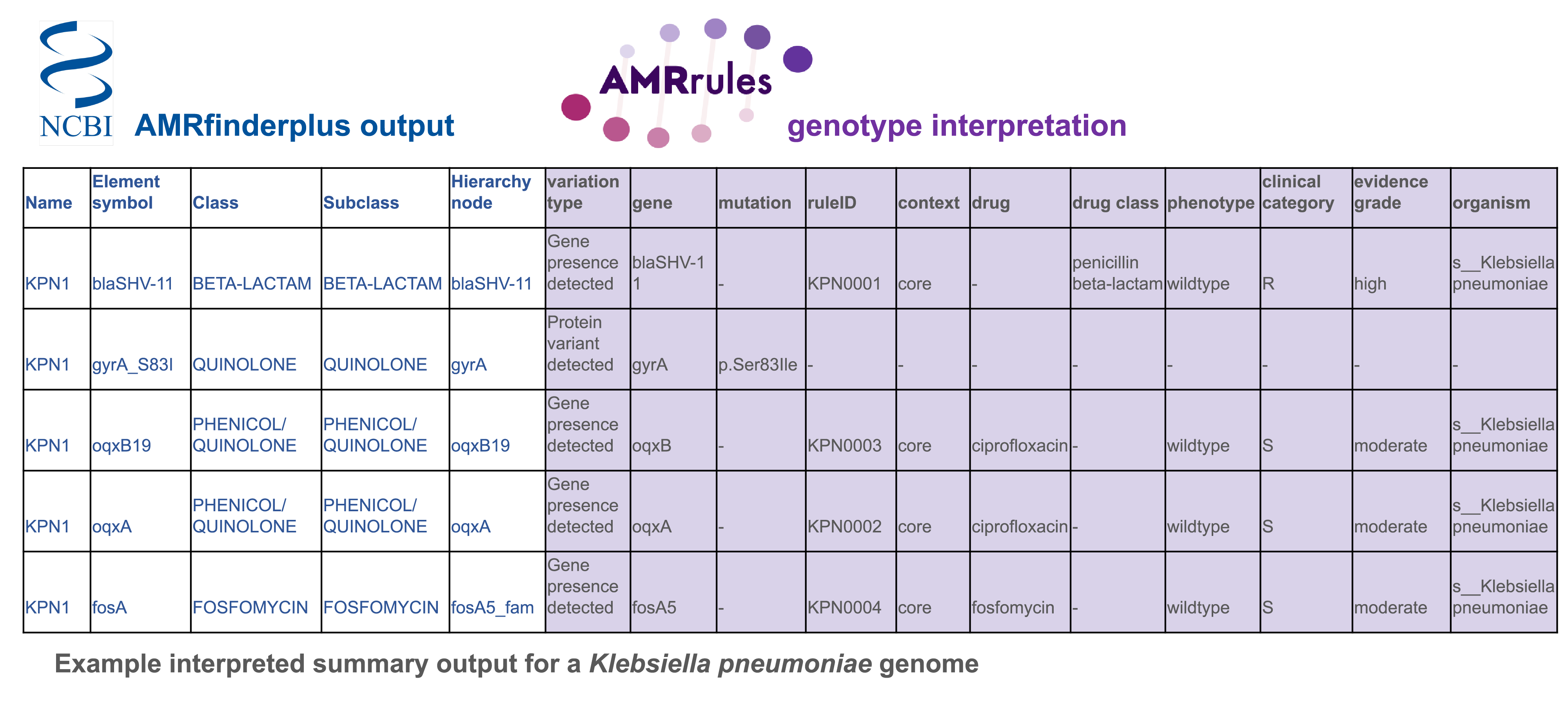
When parsing the AMRFinderPlus input file, AMRrules will first identify what variation type each genotype call belongs to, the gene found, and if there is a mutation in the gene, this mutation will be converted to the AMRrules syntax.
The table below shows the logic of how AMRrules maps AMRFinderPlus genotype calls to the different variation types:
Variation type |
AMRFP Method |
Additional logic |
|---|---|---|
Gene presence detected |
EXACT, ALLELE, BLAST |
|
Protein variant detected |
POINTX, POINTP |
|
Nucleotide variant detected |
POINTN |
|
Promoter variant detected |
POINTN |
|
Inactivating mutation detected |
INTERNAL_STOP, PARTIAL, POINTX |
If POINTX, Subtype must be POINT_DISRUPT |
The parsed variation type, gene, and mutation columns are added to the interpreted output file, next to the original AMRFinderPlus columns.
Note
If --print-non-amr is provided to AMRrules, then any additional hits from AMRFinderPlus that are not AMR-related (eg virulence, stress, or metal resistance genes) will also be included in the interpreted output file. These entries will have variation type set to Non-AMR element, and gene and mutation set to -. No rules will be applied to these entries, and all annotation columns will be set to -.
Drug mapping
AMRrules maps the AMRFinderPlus calls to drug or drug class names from the CARD ARO, by parsing the Subclass columns. The dictionary used to map AMRFinderPlus Subclass to CARD ontology is in the AMRrules repository under src/amrrules/resources/amrfp_to_card_drugs_classes.txt.
Some genotype calls have multiple entries in the AMRFinderPlus Subclass field. In such cases, the annotated calls output by AMRrules will contain multiple copies of the genotype row, one for each mapped drug/class. E.g. aac6-Ib-cr is assigned to Subclass “AMIKACIN/KANAMYCIN/QUINOLONE/TOBRAMYCIN” in refgene/AMRfinderplus, so the AMRrules-annotated genotype file will contain 4 rows for this gene, one each for drug = amikacin, drug = tobramycin, drug = kanamycin, and drug class = fluoroquinolone antibiotic
Rule matching#
When matching a genotype call with a rule, the following logic applies:
AMRrules will select all rules matching the
variation type.AMRrules will filter all possible rules to check if the
nodeIDfrom the rule matches toHierarchy node. If not, it will check the parent nodes ofHierarchy nodeto look for a matchingnodeID.If no matching
nodeIDis found, AMRrules will then check for matching accessions in the following order:nucleotide accessionprotein accessionHMM accession
For each matching rule, AMRrules appends the following fields from the rules file to the AMRFinderPlus genotype call:
ruleID
gene context
drug
drug class
phenotype
clinical category
evidence grade
version
organism
To get more detailed annotation, set --annot-opts full, which will add the following additional fields from the rule file:
breakpoint
breakpoint standard
breakpoint condition
evidence code
evidence limitations
PMID
rule curation note
Note
If multiple rules match to a genotype call, then the genotype call is duplicated, and the relevant information from additional rules is appended. For example, if the genotype call for aac(3) matches to two different rules, one for amikacin and one for kanamycin, then the aac(3) row will be represented twice in the output file, and the rule information for the amikacin will be appended on one row, and kanamycin on the second row.
The resulting output file is stored as <output_prefix>_interpreted.tsv.
Genome summary report#
In addition to the interpreted AMRFinderPlus output file, AMRrules will also generate a genome summary report, stored as <output_prefix>_summary.tsv. This file summarises the resistance per drug/drug class, based on the matched rules.
Some example output files are shown on the installation page.
The following columns are included:
Column |
Explanation |
|---|---|
sample |
Sample ID |
drug |
Drug, as per CARD ARO. AMRFinderPlus drugs will be converted to CARD ARO format by AMRrules |
drug class |
Drug class, as per CARD ARO. AMRFinderPlus drugs will be converted to CARD ARO format by AMRrules |
clinical category |
S/I/R. Highest level of resistance based on markers that match this drug/drug class |
phenotype |
Wildtype or nonwildtype. Highest level based on markers that match this drug/drug class |
evidence grade |
None/very low/low/moderate/high. Highest grade of evidence for markers that match to the highest interpretation level (nwt > wt, R > I > S) for this drug/drug class. None is used when we have no evidence for the call, as is the case of rule-less markers. |
markers (non-S) |
Markers with rules specifying clinical category I or R, separated by |
markers (no rule) |
Markers with no rule, separated by |
markers (S) |
Markers with rules specifying clinical category S, separated by |
ruleIDs |
List of IDs for single-marker rules that apply to this drug/drug class, separated by |
combo rules |
List of IDs multi-marker (combination) rules that apply to this drug/drug class, separated by |
organism |
Organism whose rules were applied |
Marker labels
Marker labels are formatted as
gene:mutation, where the mutation is formatted using AMRrules syntaxIf the variation type is
Gene inactivating mutationthe marker will be labelled asgene:-(where the-implies inactivation or functional loss).If the variation type is
Gene presence detected, the marker label will be simplygene.If
flag-corehas been switched on, markers with rules that havegene context == 'core'will be flagged with(core)after the marker. This is the case only if thevariation typefor that marker isGene presence detected. eg the core blaSHV gene in K. pneumoniae will now be in themarkers (non-S)column asblaSHV-11 (core)for penicillin beta-lactam.
Note
AMRFinderPlus genotype calls detected using POINT_DISRUPT contain detailed information about the disruption, which is formatted using HGVS syntax. For simplicity, by default the AMRrules genome summary report will not show the full mutation after the gene when listing these markers in the genome summary (although they can always be found in the annotated genotype report). Rather, they will be formatted in the genome summary report as gene:- as per other inactivating mutations. If you wish to show the full mutation detected by AMRFinderPlus in the summary report, this can be turned on by providing the option --full-disrupt to the AMRrules call.
Combination Rules#
The genome summary report is where combination rules are applied. For each drug or drug class, the engine extracts all individual rules that have been applied. It then searches the combination rules for this organism and evaluates the logic strings (e.g. “rule1 & rule2 | rule3”) to determine if any apply. If they do, the engine then applies the logic of the combination rule to the call for this drug or drug class, but only if this combination rule would create the ‘most resistant’ interpretation (where nonwildtype > wildtype for phenotype, and R > I > S for clinical category).
See details about the rules specification for more information on combination rules and how they are used.
Handling unmatched genotype calls#
By default, if no organism-specific rule is found for a genotype reported by AMRfinderplus, AMRrules will apply an interpretation based on the setting of --no-rule-interpretation. The options for this parameter are:
none(default): any unmatched genotype calls will not be assigned to a phenotype or clinical category (entires will be-). Evidence grade will be set tonone, as we are not interpreting a phenotype or clinical category.nwt: any unmatched genotype calls will be assigned the phenotypenonwildtype, but no clinical category will be assigned. Evidence grade will be set tonone, as we are not interpreting a clinical category.nwtS: any unmatched genotype calls will be assigned the phenotypenonwildtypeand clinical category will be set toS. Evidence grade will be set tonone, as there is no evidence for the call.nwtR: any unmatched genotype calls will be assigned the phenotypenonwildtypeand clinical category will be set toR. Evidence grade will be set tonone, as there is no evidence for the call.
To demonstrate the difference between these options, you can compare the output files for the same genome, a MDR Klebsiella pneumoniae strain, using different interpretations for markers with no rules.
Using none (see tests/data/example_output/test_kpneumo_MDR_none_genome_summary.tsv):
Almost all markers have no rules, and so no clinical category, phenotype or evidence grade are set. In the case of the call for penicillin beta-lactam, we have an existing wildtype R rule for blaSHV-1. However, due to the presence of blaTEM-1, which has no rule, we set phenotype to -. However the clinical category of R remains, as regardless of the S/I/R category for the marker with no rule, an R clinical category is still expected.
sample |
drug |
drug class |
clinical category |
phenotype |
evidence grade |
markers (non-S) |
markers (no rule) |
markers (S) |
ruleIDs |
combo rules |
organism |
|---|---|---|---|---|---|---|---|---|---|---|---|
SAMD00055732 |
gentamicin |
aminoglycoside antibiotic |
none |
aac(3)-IId;aac(6’)-Ib4 |
s__Klebsiella pneumoniae |
||||||
SAMD00055732 |
streptomycin |
aminoglycoside antibiotic |
none |
aph(3’’)-Ib;aph(6)-Id |
s__Klebsiella pneumoniae |
||||||
SAMD00055732 |
(all) |
carbapenem |
none |
blaIMP-4 |
s__Klebsiella pneumoniae |
||||||
SAMD00055732 |
trimethoprim |
diaminopyrimidine antibiotic |
none |
dfrA14 |
s__Klebsiella pneumoniae |
||||||
SAMD00055732 |
(all) |
fluoroquinolone antibiotic |
none |
qnrB1 |
s__Klebsiella pneumoniae |
||||||
SAMD00055732 |
ciprofloxacin |
fluoroquinolone antibiotic |
none |
qnrB1 |
oqxA;oqxB |
KPN0002;KPN0003 |
s__Klebsiella pneumoniae |
||||
SAMD00055732 |
azithromycin |
macrolide antibiotic |
none |
mph(A) |
s__Klebsiella pneumoniae |
||||||
SAMD00055732 |
erythromycin |
macrolide antibiotic |
none |
mph(A) |
s__Klebsiella pneumoniae |
||||||
SAMD00055732 |
spiramycin |
macrolide antibiotic |
none |
mph(A) |
s__Klebsiella pneumoniae |
||||||
SAMD00055732 |
telithromycin |
macrolide antibiotic |
none |
mph(A) |
s__Klebsiella pneumoniae |
||||||
SAMD00055732 |
(all) |
penicillin beta-lactam |
R |
none |
blaSHV-1 |
blaTEM-1 |
KPN0001 |
s__Klebsiella pneumoniae |
|||
SAMD00055732 |
fosfomycin |
phosphonic acid antibiotic |
S |
wildtype |
moderate |
fosA |
KPN0004 |
s__Klebsiella pneumoniae |
|||
SAMD00055732 |
(all) |
sulfonamide antibiotic |
none |
sul2;sul1 |
s__Klebsiella pneumoniae |
||||||
SAMD00055732 |
(all) |
third-generation cephalosporin |
none |
blaCTX-M-15;blaOXA-1 |
s__Klebsiella pneumoniae |
||||||
SAMD00055732 |
(n/a) |
antibiotic efflux |
none |
emrD |
s__Klebsiella pneumoniae |
||||||
SAMD00055732 |
catB3:-;aac(3)-IIe:- |
none (partial hits) |
s__Klebsiella pneumoniae |
Using nwt (see tests/data/example_output/test_kpneumo_MDR_nwt_genome_summary.tsv):
Now, all drugs with markers that have no rules have nonwildtype as their phenotype. This includes the call for penicillin beta-lactam. Evidence grades are set to none as we have no evidence for these calls.
sample |
drug |
drug class |
clinical category |
phenotype |
evidence grade |
markers (non-S) |
markers (no rule) |
markers (S) |
ruleIDs |
combo rules |
organism |
|---|---|---|---|---|---|---|---|---|---|---|---|
SAMD00055732 |
gentamicin |
aminoglycoside antibiotic |
nonwildtype |
none |
aac(3)-IId;aac(6’)-Ib4 |
s__Klebsiella pneumoniae |
|||||
SAMD00055732 |
streptomycin |
aminoglycoside antibiotic |
nonwildtype |
none |
aph(3’’)-Ib;aph(6)-Id |
s__Klebsiella pneumoniae |
|||||
SAMD00055732 |
(all) |
carbapenem |
nonwildtype |
none |
blaIMP-4 |
s__Klebsiella pneumoniae |
|||||
SAMD00055732 |
trimethoprim |
diaminopyrimidine antibiotic |
nonwildtype |
none |
dfrA14 |
s__Klebsiella pneumoniae |
|||||
SAMD00055732 |
(all) |
fluoroquinolone antibiotic |
nonwildtype |
none |
qnrB1 |
s__Klebsiella pneumoniae |
|||||
SAMD00055732 |
ciprofloxacin |
fluoroquinolone antibiotic |
nonwildtype |
none |
qnrB1 |
oqxA;oqxB |
KPN0002;KPN0003 |
s__Klebsiella pneumoniae |
|||
SAMD00055732 |
azithromycin |
macrolide antibiotic |
nonwildtype |
none |
mph(A) |
s__Klebsiella pneumoniae |
|||||
SAMD00055732 |
erythromycin |
macrolide antibiotic |
nonwildtype |
none |
mph(A) |
s__Klebsiella pneumoniae |
|||||
SAMD00055732 |
spiramycin |
macrolide antibiotic |
nonwildtype |
none |
mph(A) |
s__Klebsiella pneumoniae |
|||||
SAMD00055732 |
telithromycin |
macrolide antibiotic |
nonwildtype |
none |
mph(A) |
s__Klebsiella pneumoniae |
|||||
SAMD00055732 |
(all) |
penicillin beta-lactam |
R |
nonwildtype |
none |
blaSHV-1 |
blaTEM-1 |
KPN0001 |
s__Klebsiella pneumoniae |
||
SAMD00055732 |
fosfomycin |
phosphonic acid antibiotic |
S |
wildtype |
moderate |
fosA |
KPN0004 |
s__Klebsiella pneumoniae |
|||
SAMD00055732 |
(all) |
sulfonamide antibiotic |
nonwildtype |
none |
sul2;sul1 |
s__Klebsiella pneumoniae |
|||||
SAMD00055732 |
(all) |
third-generation cephalosporin |
nonwildtype |
none |
blaCTX-M-15;blaOXA-1 |
s__Klebsiella pneumoniae |
|||||
SAMD00055732 |
(n/a) |
antibiotic efflux |
nonwildtype |
none |
emrD |
s__Klebsiella pneumoniae |
|||||
SAMD00055732 |
catB3:-;aac(3)-IIe:- |
none (partial hits) |
s__Klebsiella pneumoniae |
Using nwtS (see tests/data/example_output/test_kpneumo_MDR_nwtS_genome_summary.tsv):
Now, all drugs with markers that have no rules have S as their clinical category, and nonwildtype as their phenotype. As an S call for blaTEM-1 doesn’t supercede the existing R rule for the blaSHV-1 marker, this clinical category remains the same. Again, evidence grades are set to none as we have no evidence for these calls.
sample |
drug |
drug class |
clinical category |
phenotype |
evidence grade |
markers (non-S) |
markers (no rule) |
markers (S) |
ruleIDs |
combo rules |
organism |
|---|---|---|---|---|---|---|---|---|---|---|---|
SAMD00055732 |
gentamicin |
aminoglycoside antibiotic |
S |
nonwildtype |
none |
aac(3)-IId;aac(6’)-Ib4 |
s__Klebsiella pneumoniae |
||||
SAMD00055732 |
streptomycin |
aminoglycoside antibiotic |
S |
nonwildtype |
none |
aph(3’’)-Ib;aph(6)-Id |
s__Klebsiella pneumoniae |
||||
SAMD00055732 |
(all) |
carbapenem |
S |
nonwildtype |
none |
blaIMP-4 |
s__Klebsiella pneumoniae |
||||
SAMD00055732 |
trimethoprim |
diaminopyrimidine antibiotic |
S |
nonwildtype |
none |
dfrA14 |
s__Klebsiella pneumoniae |
||||
SAMD00055732 |
(all) |
fluoroquinolone antibiotic |
S |
nonwildtype |
none |
qnrB1 |
s__Klebsiella pneumoniae |
||||
SAMD00055732 |
ciprofloxacin |
fluoroquinolone antibiotic |
S |
nonwildtype |
none |
qnrB1 |
oqxA;oqxB |
KPN0002;KPN0003 |
s__Klebsiella pneumoniae |
||
SAMD00055732 |
azithromycin |
macrolide antibiotic |
S |
nonwildtype |
none |
mph(A) |
s__Klebsiella pneumoniae |
||||
SAMD00055732 |
erythromycin |
macrolide antibiotic |
S |
nonwildtype |
none |
mph(A) |
s__Klebsiella pneumoniae |
||||
SAMD00055732 |
spiramycin |
macrolide antibiotic |
S |
nonwildtype |
none |
mph(A) |
s__Klebsiella pneumoniae |
||||
SAMD00055732 |
telithromycin |
macrolide antibiotic |
S |
nonwildtype |
none |
mph(A) |
s__Klebsiella pneumoniae |
||||
SAMD00055732 |
(all) |
penicillin beta-lactam |
R |
nonwildtype |
none |
blaSHV-1 |
blaTEM-1 |
KPN0001 |
s__Klebsiella pneumoniae |
||
SAMD00055732 |
fosfomycin |
phosphonic acid antibiotic |
S |
wildtype |
moderate |
fosA |
KPN0004 |
s__Klebsiella pneumoniae |
|||
SAMD00055732 |
(all) |
sulfonamide antibiotic |
S |
nonwildtype |
none |
sul2;sul1 |
s__Klebsiella pneumoniae |
||||
SAMD00055732 |
(all) |
third-generation cephalosporin |
S |
nonwildtype |
none |
blaCTX-M-15;blaOXA-1 |
s__Klebsiella pneumoniae |
||||
SAMD00055732 |
(n/a) |
antibiotic efflux |
none |
emrD |
s__Klebsiella pneumoniae |
||||||
SAMD00055732 |
catB3:-;aac(3)-IIe:- |
none (partial hits) |
s__Klebsiella pneumoniae |
Using nwtR (see tests/data/example_output/test_kpneumo_MDR_nwtR_genome_summary.tsv):
Finally, all drugs with markers that have no rules have R as their clinical category, and nonwildtype as their phenotype. Evidence grades are set to none as we have no evidence for these calls.
sample |
drug |
drug class |
clinical category |
phenotype |
evidence grade |
markers (non-S) |
markers (no rule) |
markers (S) |
ruleIDs |
combo rules |
organism |
|---|---|---|---|---|---|---|---|---|---|---|---|
SAMD00055732 |
gentamicin |
aminoglycoside antibiotic |
R |
nonwildtype |
none |
aac(3)-IId;aac(6’)-Ib4 |
s__Klebsiella pneumoniae |
||||
SAMD00055732 |
streptomycin |
aminoglycoside antibiotic |
R |
nonwildtype |
none |
aph(3’’)-Ib;aph(6)-Id |
s__Klebsiella pneumoniae |
||||
SAMD00055732 |
(all) |
carbapenem |
R |
nonwildtype |
none |
blaIMP-4 |
s__Klebsiella pneumoniae |
||||
SAMD00055732 |
trimethoprim |
diaminopyrimidine antibiotic |
R |
nonwildtype |
none |
dfrA14 |
s__Klebsiella pneumoniae |
||||
SAMD00055732 |
(all) |
fluoroquinolone antibiotic |
R |
nonwildtype |
none |
qnrB1 |
s__Klebsiella pneumoniae |
||||
SAMD00055732 |
ciprofloxacin |
fluoroquinolone antibiotic |
R |
nonwildtype |
none |
qnrB1 |
oqxA;oqxB |
KPN0002;KPN0003 |
s__Klebsiella pneumoniae |
||
SAMD00055732 |
azithromycin |
macrolide antibiotic |
R |
nonwildtype |
none |
mph(A) |
s__Klebsiella pneumoniae |
||||
SAMD00055732 |
erythromycin |
macrolide antibiotic |
R |
nonwildtype |
none |
mph(A) |
s__Klebsiella pneumoniae |
||||
SAMD00055732 |
spiramycin |
macrolide antibiotic |
R |
nonwildtype |
none |
mph(A) |
s__Klebsiella pneumoniae |
||||
SAMD00055732 |
telithromycin |
macrolide antibiotic |
R |
nonwildtype |
none |
mph(A) |
s__Klebsiella pneumoniae |
||||
SAMD00055732 |
(all) |
penicillin beta-lactam |
R |
nonwildtype |
high |
blaSHV-1 |
blaTEM-1 |
KPN0001 |
s__Klebsiella pneumoniae |
||
SAMD00055732 |
fosfomycin |
phosphonic acid antibiotic |
S |
wildtype |
moderate |
fosA |
KPN0004 |
s__Klebsiella pneumoniae |
|||
SAMD00055732 |
(all) |
sulfonamide antibiotic |
R |
nonwildtype |
none |
sul2;sul1 |
s__Klebsiella pneumoniae |
||||
SAMD00055732 |
(all) |
third-generation cephalosporin |
R |
nonwildtype |
none |
blaCTX-M-15;blaOXA-1 |
s__Klebsiella pneumoniae |
||||
SAMD00055732 |
(n/a) |
antibiotic efflux |
emrD |
s__Klebsiella pneumoniae |
|||||||
SAMD00055732 |
catB3:-;aac(3)-IIe:- |
none (partial hits) |
s__Klebsiella pneumoniae |