
AMRrules#
About#
Organism-specific interpretation of antimicrobial susceptibility testing (AST) data is standard in clinical microbiology, with rules regularly reviewed by expert committees of EUCAST and CLSI. We aim to provide an analagous resource to support organism-specific interpretation of antimicrobial resistance (AMR) genotypes derived from pathogen whole genome sequence (WGS) data.
AMRrules encode organism-specific rules for the interpretation of AMR genotype data. Users first take their genomes and run them through an AMR genotyping tool such as AMRFinderPlus, which identifies resistance determinants present in the genome. The resulting output can then be interpreted using AMRrules, which applies the organism-specific rules to generate a final interpreted report of predicted antimicrobial susceptibility for that genome.
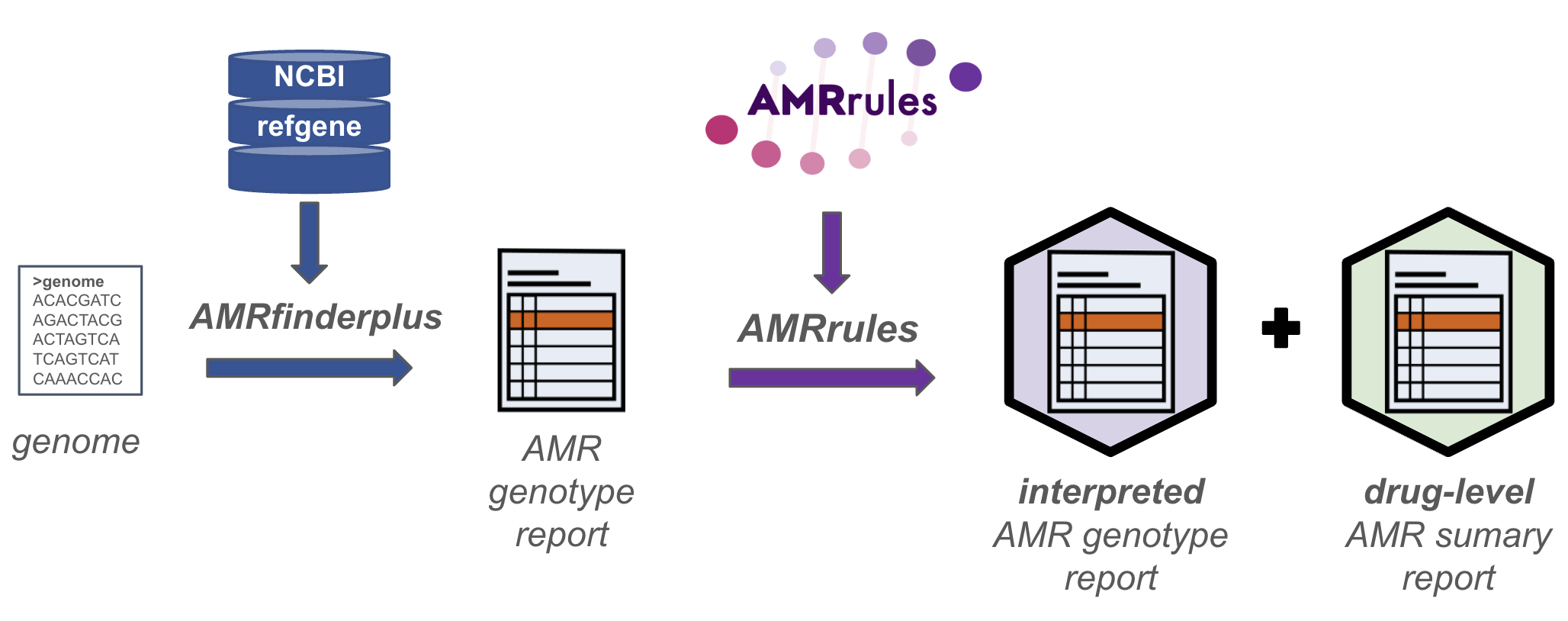
The AMRrules Python package includes the rules themselves as well as code to apply the rules to interpret AMR genotypes (currently limited to AMRFinderPlus output), generating informative genome reports that capture expert knowledge about how core and acquired genes and mutations contribute to phenotypic antimicrobial susceptibility.
Rule curation and development#
Rules are curated by organism experts belonging to ESGEM-AMR, a working group of ESGEM, the ESCMID Study Group on Epidemiological Markers. Initial rule curation has focused on defining rules for the interpretation of core genes and expected resistances, but acquired genes and mutations are included for some organisms already and will be added to others as the necessary data to define them accurately is accumulated and curated by the ESGEM-AMR working group.
Current rulesets and supported organisms can be found here or can be explored interactively in the AMRrules Browser.
The rule specification is available here.
We are focusing early development on compatibility with NCBI resources (i.e. the AMRFinderPlus genotyping tool, and the associated NCBI databases including AMR refgene, AMR Reference Gene Hierarchy, and the Reference HMM Catalog). In future we plan for interoperability with CARD and ResFinder (and other tools based on these), using hAMRonization.
More information#
An overview of the AMRrules initiative, including aims as well as completed and planned implementation phases, is available in these slides presented at the Wellcome AMR Big Data conference in March 2026 .
Citation#
If you use the AMRrules software or rules, please cite “AMRrules v1.0, URL: AMRverse/AMRrules (DOI: https://doi.org/10.5281/zenodo.12724317)”.
Source code#
Source code is available in the GitHub repository AMRverse/AMRrules.
Issues#
Bugs? Requests? Feedback? Please check the FAQs first, and if your issue is not covered then please post an issue in GitHub.
Contributors#
The AMRrules concept was initially workshopped by members of the Holt lab at London School of Hygiene and Tropical Medicine and further developed in collaboration with Jane Hawkey at Monash University. The AMRrules specification was developed by the ESGEM-AMR Data & Tools group, and the rules curated by the ESGEM-AMR Working Group (see list of members), co-chaired by Natacha Couto (ESGEM Chair).
Code was developed by Jane Hawkey and Kat Holt.